.png)
.png)
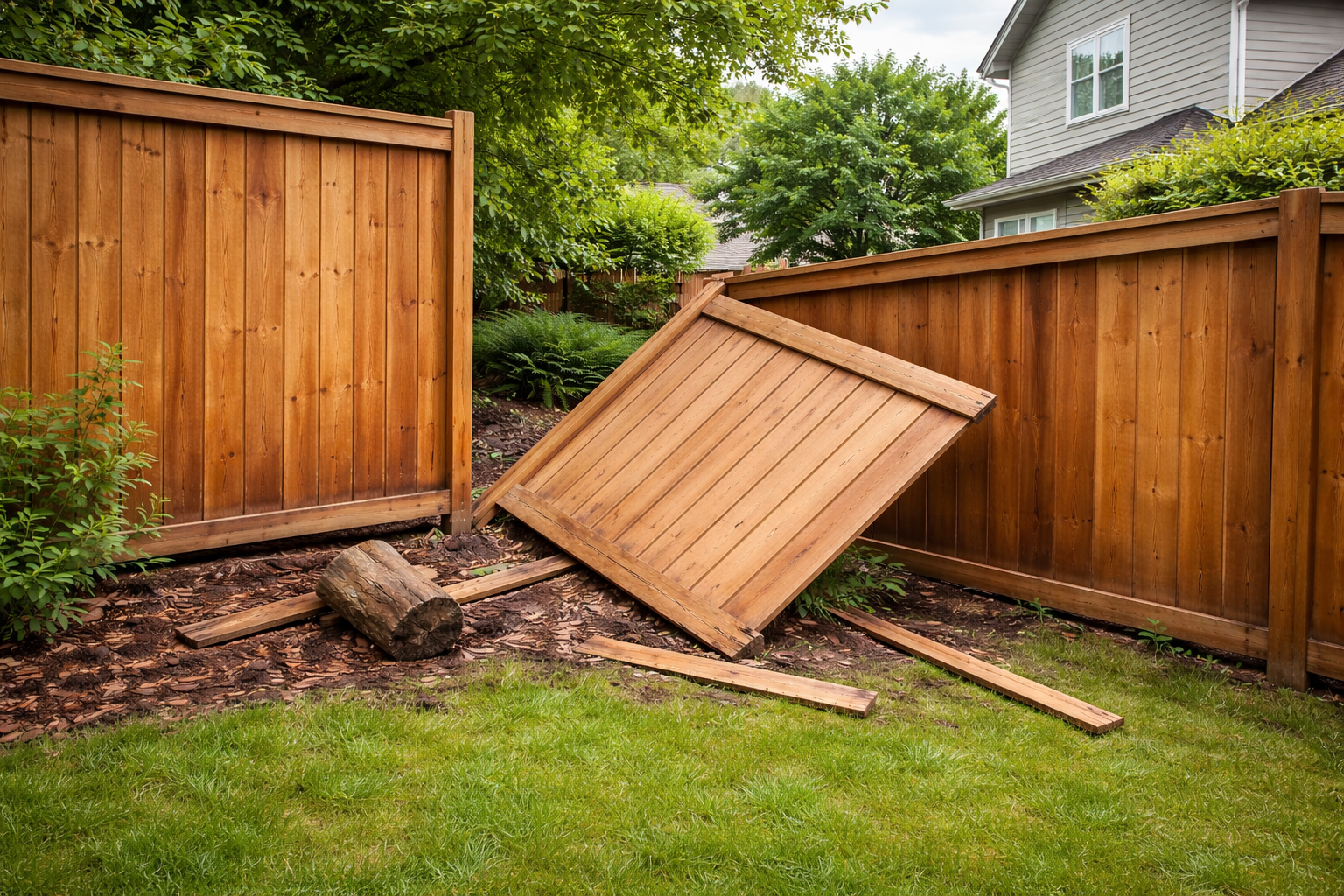
Picture this: a homeowner in Renton gets home from work, walks the backyard, and finds three fence panels flattened after a windstorm. The fence runs dead along the line shared with the neighbor. Who pays? Can they make the neighbor chip in? Do they need a permit? That single scenario kicks off the same questions thousands of Washington homeowners ask every year, so let's walk through the rules, the money, and the conversation nobody really wants to start.
What Counts as a Shared Fence Under Washington Law
Before anyone talks money, you have to know what kind of fence you actually have. Not every fence near a property line is legally "shared."
Boundary fence vs. a fence on your land alone
A fence that sits on the boundary line and serves both properties is what the law calls a partition or boundary fence. A fence built entirely inside your own yard, even if it runs parallel to the line, is just your fence and your bill.
Why the property line decides everything
The location of the line is what triggers any shared responsibility. A few things flow from that:
- A fence centered on the legal line can be a shared fence; a fence three feet inside your yard is not.
- You cannot assume the old fence marks the true line (more on that danger later).
- A boundary survey is the only way to know for certain where your line sits.
In our Renton example, the homeowner first needs to confirm those flattened panels actually sat on the line before expecting the neighbor to pitch in.
Shared Fence Law in Washington State: What RCW 16.60.020 Actually Says
Here's where most websites get it wrong. You may have seen this called the "Good Neighbor Fence Law" online. That nickname is a bit of a stretch, since the actual statute lives in livestock law, but it is the rule people are usually pointing to, and knowing what it really says puts you ahead.
Shared fence law in Washington state traces back to RCW 16.60.020, the Washington fence cost splitting law that lives in Title 16, the state's animals and livestock code. It says that when one person builds a fence on the boundary line and the adjoining owner later encloses their own land so the fence also serves them, that neighbor pays one-half the value of the portion serving as the partition fence.
The catch most homeowners miss
That law was written for farms and grazing land, not subdivisions. So in a typical residential setting:
- There is no modern Washington statute that automatically forces your neighbor to pay half for a backyard privacy fence.
- The cost split between neighbors is driven by mutual agreement far more than by this statute.
- When neighbors do agree to share, splitting the cost evenly is the common practice, not a legal command.
The practical takeaway: treat the law as your backup, not your opening move. Your real leverage is a fair conversation and a written agreement, which we will get to.

Who Pays for a Fence Between Neighbors in Washington State
So who actually writes the check? In most Washington neighborhoods, it comes down to who wants the fence and what the two of you work out together.
When costs are typically shared
- Both property owners want the fence and both will use it for privacy, pets, or kids.
- The fence sits on the shared boundary line and benefits both yards equally.
- You agreed together, ideally in writing, before the fence installation began.
When you likely pay on your own
- You want a premium cedar fence and your neighbor is fine with what is there.
- The fence sits fully inside your property boundaries.
- Your neighbor never agreed to the project or the estimated cost.
For real numbers, a standard six-foot cedar privacy fence in the Puget Sound area commonly runs somewhere in the range of $35 to $60-plus per linear foot installed, depending on materials, terrain, and how many old panels have to be hauled away. On a shared run, splitting that fairly is exactly the conversation worth having up front rather than after the invoice lands.
Property Line Rules Every Washington Homeowner Should Know
You cannot talk about a shared fence without talking about where it is allowed to go and how tall it can be. Fence on property line rules are mostly local, so this is where city and county codes matter more than state law.
Who owns which side of the fence
There is a stubborn myth that the "good side" faces out and tells you who owns the fence. It does not. Ownership comes down to who paid for it and whose property it sits on, not which way the finished side points.
Height limits and setbacks across Washington cities
Front yard and backyard limits are different, and they vary by city:
- In Seattle, neighborhood residential zones cap fences at 6 feet, with up to 2 more feet allowed for features like a trellis or arbor.
- Seattle limits fences in a front or street-side setback to 4 feet.
- In unincorporated King County, you can generally build up to 6 feet without a permit; taller fences need a permit and must meet setbacks.
- Corner lots almost everywhere have a "sight triangle" near the street where fences must stay low for driver visibility.
Where to check your local laws and fence rules
- Your city or county permitting office (Seattle's SDCI, or your local equivalent in Bellevue, Tacoma, Everett, and so on).
- The county assessor or parcel viewer for lot lines and zoning.
- Your HOA, if you have one, since HOA rules can be stricter than the city and approval is separate.
How to Ask a Neighbor About Splitting Fence Costs
This is the part property owners dread, but a five-minute conversation beats a five-month standoff. Splitting fence cost with a neighbor is mostly about timing: agree on the fence installation and the split before anyone starts digging post holes.
A simple way to bring it up
Keep it low pressure and specific. Something like: "Hey, our shared fence took a beating in that last storm. I'm planning to replace it and would love to split the estimated cost if you're open to it. Want to look at a couple of quotes together?"
What to bring to the table
- One or two written estimates so the numbers are concrete.
- Confirmation of where the property boundaries sit.
- A clear proposed split, usually 50/50 for a fence you both use.
Get it in writing, then keep the money clean
A short written agreement protects both of you if someone sells the house or forgets the deal six months later. The billing side matters just as much. When the cost is split, having a separate invoice for each neighbor means nobody has to front the entire amount and then chase the other party for a reimbursement check. That one detail removes most of the friction from a shared fence project.

When Neighbors Disagree: Resolving a Fence Dispute
Sometimes the conversation does not go smoothly. A neighbor fence dispute is rarely worth torching a relationship over, so escalate slowly and keep it civil.
Start with the agreement
Go back to what you discussed or wrote down. Many disputes are just misunderstandings about scope, materials, or where the boundary line actually runs. A quick survey can settle the property boundaries question fast.
Try mediation before anything formal
Washington has a network of Dispute Resolution Centers that offer low-cost or free community mediation. A neutral third party often resolves a fence disagreement for a fraction of the cost and stress of legal action.
Small claims as a last resort
- Washington small claims court currently handles disputes up to $10,000 for individuals (the limit is lower for businesses).
- You do not need a lawyer to use it.
- Realistically, most shared fence disputes settle well before this, and a courtroom rarely improves a neighbor relationship.
Don't Let an Old Fence Line Quietly Cost You Land
Here is the risk that catches Washington homeowners off guard, and it is why "just rebuild where the old one was" is dangerous advice.
How adverse possession works in Washington
Under RCW 4.16.020, Washington's statutory period for adverse possession is 10 years. That means someone who continuously occupies disputed land as an owner would, for at least ten years, may be able to claim it.
- For the claim to hold, the use generally has to be:
- Actual (they physically used the land like an owner)
- Open and obvious (not hidden)
- Exclusive (not shared with the true owner)
- Without the owner's permission
A fence sitting in the wrong spot for years is one of the most common adverse possession triggers Washington homeowners run into.
Why you should never assume the old line is correct
- The previous fence may have been built feet off the true boundary line.
- Rebuilding on a wrong line can lock in a boundary mistake or hand a strip of yard to whoever has been using it.
- A current survey before you rebuild protects your property rights and your investment.
Getting Your Shared Fence Project Started Right
Strip away the legal jargon and three principles cover almost every shared fence project in Washington:
- Confirm the property line with a survey before you build.
- Agree on a fair cost split, and get it in writing.
- Check your local city or county laws on height, fence installation permits, and fence maintenance.
The law is rarely the hard part. The conversation is, and once that's handled, the rest is just good fence building. If you'd rather not navigate the line-walking, cost-splitting, and permit questions alone, Optima Fence and Deck handles shared fence projects across Washington every week. They'll even issue a separate invoice to each neighbor so nobody fronts the whole bill or chases the other side for repayment, a detail customers like Jared Greiner called out after his project. Ready to turn that dreaded fence conversation into a finished fence? Talk to us today for a clear, fairly split estimate.
FAQs
Does Washington state law require my neighbor to split the cost of a shared fence?
Not automatically. The old partition fence statute comes from livestock law, so in most residential cases the split depends on a mutual agreement between you and your neighbor rather than a rule forcing them to pay half.
What is RCW 16.60.020 and how does it affect my fence?
It is Washington's partition fence reimbursement statute. It provides that when a fence sits on the boundary line and the adjoining owner encloses their land so the fence also serves them, that owner pays half the value of the partition portion. It originates in the state's animals and livestock code, so its direct reach into modern backyard fences is limited.
Do I have to pay for half my neighbor's fence if I never agreed to it?
Generally, no. If you never agreed to the project and the fence mainly benefits your neighbor or sits on their land, you usually cannot be forced to cover half. Agreement is what creates a shared obligation in most residential situations.
Who owns the fence on the property line between two homes?
Ownership comes down to who paid for it and whose property it sits on. The old "the good side faces the owner" idea is a myth and does not determine legal ownership.
How tall can I build a fence in Washington without a permit?
It varies by city. In Seattle's neighborhood residential zones, fences are generally capped at 6 feet (with limited room for features like a trellis), and front-setback fences are limited to 4 feet. In unincorporated King County you can usually go up to 6 feet without a permit. Always confirm with your local jurisdiction.
Can a fence built in the wrong spot really change my property line?
It can. Because Washington's adverse possession period is 10 years, a fence sitting on the wrong line for that long can support a boundary claim. That is why a survey before rebuilding is so important.
What should I do if my neighbor refuses to pay for a shared fence?
Start by revisiting your agreement and confirming the property line. If that stalls, Washington's community Dispute Resolution Centers offer affordable mediation, and small claims court is a last resort for disputes currently capped at $10,000 for individuals. Most cases settle well before that point.



.png)







.svg)